⚠️ This forum has been restored as a read-only archive so the knowledge shared by the community over many years remains available. New registrations and posting are disabled.

All times are UTC + 8 hours


Post new topic Reply to topic  [ 34 posts ]  Go to page Previous  1, 2, 3  Next
Author Message
PostPosted: Mar 8th, '16, 03:06 
Newbie
Newbie

Joined: Mar 5th, '16, 08:55
Posts: 16
Gender: Male
Are you human?: yes
Location: Utah, USA
Indeed.

http://www.amazon.com/Galaxyhydro-200pcs%C3%973w-Greenhouse-Growing-Flowering/dp/B00INM0DSG/ref=sr_1_11?ie=UTF8&qid=1457377363&sr=8-11&keywords=led+grow+lights

I have not tried this particular light, but it gives you an idea. It takes a lot of juice, as well as a variety of spectrum / colors to grow vegies indoors.

Leafy stuff, like cabbage, lettuce, broccoli, etc are much less light intensive.

But you can't have a garden without tomatoes!!


Top
 Profile  
Reply with quote  
    Advertisement
 
PostPosted: Mar 8th, '16, 04:54 
Moderator
Moderator
User avatar

Joined: Aug 26th, '10, 07:17
Posts: 9104
Gender: Male
Are you human?: YES
Location: Oregon, USA
Here's another solar greenhouse thread that might have some information or ideas you can use - http://www.backyardaquaponics.com/forum/viewtopic.php?f=18&t=24884


Top
 Profile  
Reply with quote  
PostPosted: Mar 8th, '16, 05:59 
Legend Member
Legend Member
User avatar

Joined: Dec 1st, '15, 11:54
Posts: 528
Gender: Male
Are you human?: YES
Location: Guanacaste, Costa Rica
A common grow-light rule of thumb from back in the day when folks used Metal Halide fixtures for vegetative growth and the High Pressure Sodium (HPS) fixtures for flowering was, for high-light plants like tomatoes use around 40 watts per square foot for optimal growth and fruit production. For low light plants, and small leafy plants like herbs and lettuce, use about 25 to 30 watts per square foot. I never thought specifying things like that in watts made much sense since obviously it is lumens that matter, now how much power is used to generate those lumens.

In HortTechnology, the mag for the American Society for Horticultural Science, a study published in 2013 comparing HPS to LED lighting for indoor tomato growing, found that each plant grown using traditional HPS lighting used 1224 kilowatt-hours of energy through the season, while those under LEDs consumed just 294 kilowatt-hours. About 25% of the energy growing with LED to produce the same yield.

Image

The reprint of that article is available here:

Comparison of Intracanopy Light-emitting Diode Towers and Overhead High-pressure Sodium Lamps for Supplemental Lighting of Greenhouse-grown Tomatoes

Don't throw out your tomatos just yet, Deuem! :naughty:

--
Sam


Top
 Profile  
Reply with quote  
PostPosted: Mar 8th, '16, 16:24 
Quote:
In HortTechnology, the mag for the American Society for Horticultural Science, a study published in 2013 comparing HPS to LED lighting for indoor tomato growing, found that each plant grown using traditional HPS lighting used 1224 kilowatt-hours of energy through the season, while those under LEDs consumed just 294 kilowatt-hours. About 25% of the energy growing with LED to produce the same yield.


OK, that's more like it a 75% savings in cost for the same kick.

I have a test rig AP setup that currently has one over head round light fixture. 2 poles hold that up and I was going to mount 2 T5/90 Bulbs and fixtures to them. With a little change to the base it could be made to hold 4 of these so it would surround the cage. I will put some cherry tomatoes seeds in the rotation and see if I can get them to sprout. I am thinking that this system will be purely Hydroponic so I can add stuff they need. These single setups are 10L water and 15L GB. Being so small they are useless for fish anyway. No matter which way I go I still think I will use FT water to top them off as I do now. Maybe I will use the new plastic fish in the FT. Make people guess.


Top
  
Reply with quote  
PostPosted: Mar 8th, '16, 20:58 
Legend Member
Legend Member
User avatar

Joined: Dec 1st, '15, 11:54
Posts: 528
Gender: Male
Are you human?: YES
Location: Guanacaste, Costa Rica
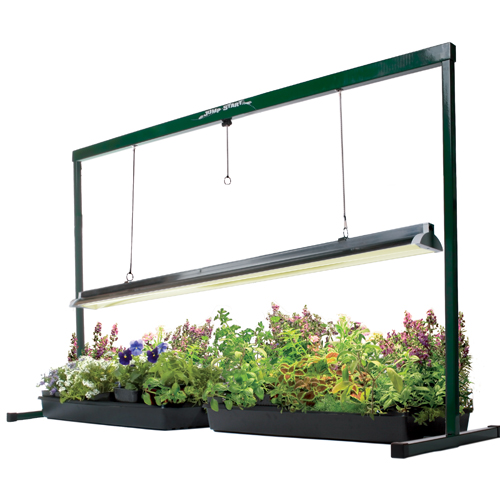
If you use fluorescents, the high output T5's are much better than standard industrial fluorescents. The T-5 lights triple the light output of normal fluorescent lights for the same wattage. Plants absorb a high percentage of T-5 lighting because the fixtures function well very close to plants. So the idea is usually to have fluorescents very close to the battlefield, perhaps 75-100mm away from the plants. Moveable light fixtures become much more important than when using mini-sols like HPS.

Here are a couple examples:

Image
Smaller good for seedlings
Image
Larger good for growth

Sometimes you've gotta use what you've got to use. Plus fluorescent light fixtures of whatever shape you wish to make, can be easily crafted out of wood and ballasts and wiring directly out of standard fixtures. If you want a tanning bed of light for your tomatoes you can build it.

Image
:headbang:
--
Sam


Top
 Profile  
Reply with quote  
PostPosted: Mar 8th, '16, 21:49 
The lights I bought are 6500K. My eyes still hurt from looking at it without the cover, 60 minutes later. Very bright for sure. With a standard florescent bulb I can stare at it with no problems. I think the long tubes are 6,000K. I do like the ability of being able to raise or lower the light as shown above. I will have to incorporate that feature on the round ones somehow. Inside the round fixture are 4 strips of rectangular LEDs. It almost looks like it is garbage in there. Like white electrical tape with bumps.

If push comes to shove, the tomatoes will find their way to the balcony. I only want to grow one plant and have a baby chasing it for rotation.

nosliwmas: That is a good article and I saved the PDF to print out and give it a good solid read. It looks like they were using 80% red and 20% blue LEDS. Mine are all white. I have 2 friends that own LED factories and the next time I run into to them I will ask if they can adjust what LEDs go on those strips. There are 7 LEDs per strip, 4 strips. Ask them to use 1 white, 5 red and 1 blue. The percentages will be close enough and I will still have some white light to see things. So maybe there is something here and I just don't know it yet. maybe next year we will be selling LED grow lights. lol


Top
  
Reply with quote  
PostPosted: Mar 8th, '16, 22:18 
Newbie
Newbie

Joined: Mar 5th, '16, 08:55
Posts: 16
Gender: Male
Are you human?: yes
Location: Utah, USA
Thank you nosliwmas!
That is a great article.

Here in lies the problem. Even with LED's you still end up paying (based on the math from your post) roughly $35 per plant, over the course of a season. Multiply that out by 100 plants, and it quickly becomes financially unwise. ($3,500)

I have been researching the possibility of installing solar panels on the roof of the barn to offset this cost. And will likely go that route regardless of whether I use a poly-carbonate greenhouse, or a metal outside.

Honestly, like I say, my biggest hangup with the greenhouse finish has been having to replace it every ten years. Each time, myself being ten years older, and more tired.

Nevertheless, if I can find a viable option that will last a minimum of 20 years, I just can see spending that much energy, when I can get it for free from the Sun!


Top
 Profile  
Reply with quote  
PostPosted: Mar 9th, '16, 01:07 
For what I was thinking on doing, 4 plants per bulb, round or long, The number I came up to is 47 cents per plant per week. If Lettuce is on a 4 week rotation that would be 1.90 a head or less then half of what we pay for it now, in season. I also added in the water pump cost. Of course we all need to run the same equation to get real debatable numbers. Can't forget the seedling costs? If you want to print your equation we can all run the same numbers. Total Watts/Hours a day/x7/1,000/x watt hr $/ divided by plants per light/pump x rotation time/+ seedling cost. Then there is always ROI. The first simple one I did told me 2 years. I want 1 year if possible. Now none of this is really a make or break issue with me, it is just smart to know what one is up against in any hobby. I am doing it for the quality of food for the family. Not the money.
D


Top
  
Reply with quote  
PostPosted: Mar 9th, '16, 02:19 
Moderator
Moderator
User avatar

Joined: Aug 26th, '10, 07:17
Posts: 9104
Gender: Male
Are you human?: YES
Location: Oregon, USA
nosliwmas wrote:
If you use fluorescents, the high output T5's are much better than standard industrial fluorescents. The T-5 lights triple the light output of normal fluorescent lights for the same wattage. Plants absorb a high percentage of T-5 lighting because the fixtures function well very close to plants.


A lot just depends on the bulbs you buy. T8's and the different types of T5's can be very close in the lumens per watt that they deliver. The HO T5 bulbs are designed to operate at a higher wattage and that's a large portion of the difference in lumens they deliver vs the T8's which only operate at 32 Watts. For some types of plants the difference isn't worth the premium you pay but for Tomatoes it might be :dontknow:. See table 1 in the link below for a comparison.

http://www.aeeohio.com/AEE_Cleveland_FL_Lighting_Sternberg%202222005.pdf


Top
 Profile  
Reply with quote  
PostPosted: Mar 9th, '16, 11:12 
Hey Scotty, that article is good but it is 11 years old. Our new T5s are all LEDs and only 12 watts. It looked like the T5s of old were also gas models. They mentioned they get hot. This new bulb is cool to the touch. This 12 watt unit is twice as bright as the old 32 watt fluorescent tubes they replace. It is like daylight wen you turn them on and 12 watts is the smallest one they had, The tech on these is changing faster then we can field test them for a season.
D


Top
  
Reply with quote  
PostPosted: Mar 9th, '16, 11:40 
Moderator
Moderator
User avatar

Joined: Aug 26th, '10, 07:17
Posts: 9104
Gender: Male
Are you human?: YES
Location: Oregon, USA
I haven't looked into the LED version of the T5 bulbs recently but they are coming down in price. At one point I know they weren't the best option but like you said, things are changing fast :headbang:


Top
 Profile  
Reply with quote  
PostPosted: Mar 9th, '16, 12:08 
My T5/90mm 14 watt long was 33 rmb and the 12 watt round one was 52 RBM at the local hardware store. About 10 to 20% more then the old ones. They just came out so I expect the price to fall with competition. the new pumps I found are 3.5 watts each and deliver 150 liters an hour @ 50cm head height. 3.9 USD each. The new single air pump is 3 .2 watts and can assist where needed. 2.8 USD each. I am trying not to have the electric company use all the food money.

Our 1 watt hour is something like 0.95 rmb and cheaper at night. Commercial is more like 1.5 and on all sorts of scales.
D


Top
  
Reply with quote  
PostPosted: Mar 9th, '16, 13:10 
Xtreme Contributor
Xtreme Contributor

Joined: Oct 9th, '14, 12:16
Posts: 182
Gender: Male
Are you human?: For but a moment...
Location: W. N. America.
Scotty, that's a great link. Thanks.

FinnyWiggen, again, there are others more knowledgeable than me, and you may already know this, but in the link you posted for the led growlight, the references to veg and flower refer to a specific set of conditions, primarily required by one crop. (think illegal basement grow op.)

That crop requires particular light spectra for it's flowering stage, which is most of what these light sales pages are referring to. It also benefits from higher light densities than most plants require, I believe. (Someone please correct me if I am wrong here!) Few or no commonly grown greenhouse/indoor food crops are particularly sensitive to changing light spectra, or day length, beyond requiring a minimum amount of light to maintain growth.

I'm outside my field of knowledge a little here, but I did run a couple 250W MH lights in my GH this winter as supplementals before sun up and after dusk. A 100 w led will throw more light than the 250w MH, and I am certain that they would each sustain two full tomato plants if properly rigged. (I got the lights free, and power is relatively cheap in my neighborhood.~$5/month to run 3 hrs/day) Unfortunately, temperature and fungus prevented me from having much success this year.

That said, I have also proven to myself that more sun will trounce any amount of artificial light that I can rig under any realistic circumstance. Hence my advice to pursue the Greenhouse addition, rather than relying on artificial light.


Top
 Profile  
Reply with quote  
PostPosted: Mar 9th, '16, 21:41 
Newbie
Newbie

Joined: Mar 5th, '16, 08:55
Posts: 16
Gender: Male
Are you human?: yes
Location: Utah, USA
Gingerbread,

My personal experience has been that you can grow great tomato plants with a variety of lighting setups. However getting them to flower and fruit is another issue.

In the past this has not been a problem, because I was starting them inside, and finishing them in the outside garden. However, if I am going to grow them entirely inside, then I need the right spectrum for the flowering and fruiting stages. I would love to hear though if someone has had success with cheaper / dimmer lights in the flowering / fruiting stages.


Top
 Profile  
Reply with quote  
PostPosted: Mar 9th, '16, 22:52 
Legend Member
Legend Member
User avatar

Joined: Dec 1st, '15, 11:54
Posts: 528
Gender: Male
Are you human?: YES
Location: Guanacaste, Costa Rica
I'm sure you guys saw this Science Alert, right? :D

World’s first underground urban farm opens for business in London

Image

Deuem, perhaps if we each start digging, we can meet up in the middle to outdo the London tunnel guys? :headbang:

--
Sam


Top
 Profile  
Reply with quote  
Display posts from previous:  Sort by  
Post new topic Reply to topic  [ 34 posts ]  Go to page Previous  1, 2, 3  Next

All times are UTC + 8 hours


You cannot post new topics in this forum
You cannot reply to topics in this forum
You cannot edit your posts in this forum
You cannot delete your posts in this forum
You cannot post attachments in this forum

Search for:
Jump to:  
cron

Powered by phpBB® Forum Software © phpBB Group
Portal by phpBB3 Portal © phpBB Türkiye
[ Time : 0.229s | 16 Queries | GZIP : Off ]