⚠️ This forum has been restored as a read-only archive so the knowledge shared by the community over many years remains available. New registrations and posting are disabled.

All times are UTC + 8 hours


Post new topic Reply to topic  [ 31 posts ]  Go to page 1, 2, 3  Next
Author Message
 Post subject: Detecting pump failure
PostPosted: Apr 23rd, '12, 09:47 
Bordering on Legend
Bordering on Legend

Joined: Apr 19th, '12, 13:04
Posts: 443
Gender: Male
Are you human?: huumon?
Location: ACT
I'm looking at picking up a water and air pump to run in my system but i'm very much interested in redundancy and was wondering how people detect their pump failure. ie not power failure but just a mechanical failure of the pump.

I'm trying to design my redundancy system so if any component carks it, a redundant one will kick in and carry on.


Top
 Profile  
Reply with quote  
    Advertisement
 
PostPosted: Apr 23rd, '12, 10:08 
Legend Member
Legend Member
User avatar

Joined: Aug 3rd, '09, 06:50
Posts: 956
Location: Bullsbrook
Gender: Male
Are you human?: 01011001011001010111
Location: Western Australia
Two pumps with float switches, one set to come on at a higher water level, lower pump does all the work and if it dies the water level rises and second pump starts working until you notice and replace pump one.


Top
 Profile  
Reply with quote  
PostPosted: Apr 23rd, '12, 10:45 
Moderator
Moderator
User avatar

Joined: May 6th, '11, 12:06
Posts: 12206
Gender: Male
Location: Northern NSW
Yea as simo said.....its really a visual thing, pumps generally die over time and reduce in flow or in some cases just straight out failure.

You could monitor current draw but it wouldnt be an accurate tell tale sign anyway because in some cases the current draw would increase as bearing etc wear but then if the impeller was wearing away then you would probably see less current draw. The point is if you have the time to test these things...you might as well just check your flow and inspect the pump itself, which you should be doing regularly anyway.

Im a maintenance planner and a big part of my job is to monitor component life and in the mining industry this can be difficult as there is so many variables.

In the situation of AP with a submursable water pump under the same continuous load you would still need a history to make even a ball park avaluation.

I think with regular maintenance and inspections you should get a good couple of years from a mid range submerable pump.


Top
 Profile  
Reply with quote  
PostPosted: Apr 23rd, '12, 10:46 
Legend Member
Legend Member
User avatar

Joined: Jun 1st, '10, 22:14
Posts: 729
Gender: Male
Are you human?: I hope so
Location: Hills east of Perth
+1 Simo
Creative pumps in SA (http://www.creativepumps.com.au/work/float_switches/luise/luise_float_switches.htm8 have a special on at the moment for Float switches ($59 - reduced from $79) which is a bargin. No excuse for anyone not to have a float switch if only to prevent a pump out due to a pump failure in the sump etc.
Cheers
Marc


Top
 Profile  
Reply with quote  
PostPosted: Apr 23rd, '12, 10:48 
Xtreme Contributor
Xtreme Contributor
User avatar

Joined: Nov 16th, '11, 09:56
Posts: 202
Location: Adelaide
Gender: Male
Are you human?: YES
Location: South Australia
[quote="tcshad"] ie not power failure but just a mechanical failure of the pump.quote]
I guess you need to detect water pressure and/or water flow, for the water pump side of things.
You can get free switches/sensors from discarded dishwashers.
Without putting too much thought into it, I would go for a mechanical sensor that Incorporated a magnet and reed switch.
This reminds me of a sensor found in vehicle brake fluid bottles.
When the container is full, the magnet, sealed and on a float, is at the top of the container. Empty, magnet at bottom. Please yourself whether you have the reed switch sensor top or bottom.
So, your pump fills the FT or GB. The delivery pipe end first empties into a small container. This container contains the magnet and has a drain, which is smaller then input flow, so container is continuously full and overflowing and also draining. If flow stops, container empties and magnet drops to bottom.

You need to interface this so that, when the power is on, and the magnet is at bottom, the fault is detected.

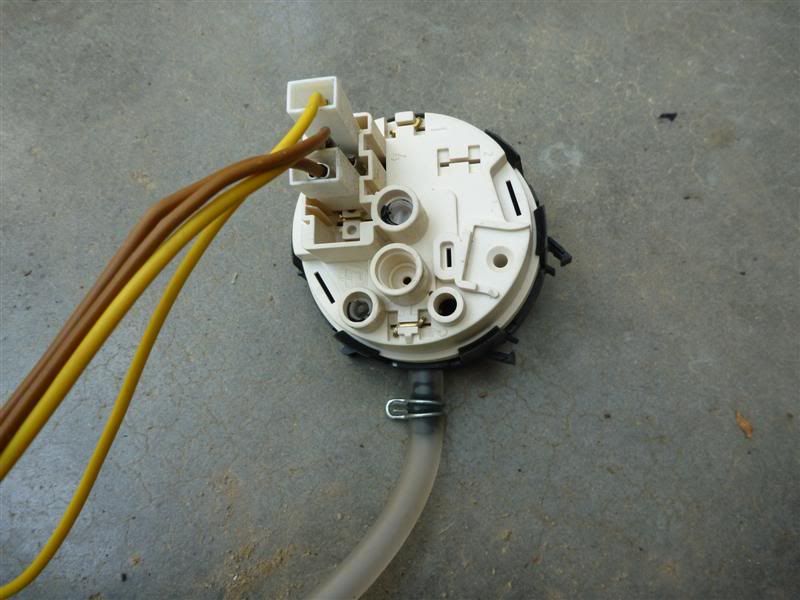
The air pump is the easiest. All you need to do is to place a T adaptor on your hose and plug in an ex washing machine pressure sensor.

You can also use these sensors to monitor your water pump pressure. But I don't have time to explain this right now, so hope someone else will or will do myself later. One needs to be cautious here as, if the seal leaks, you could end up with water in the electrics.

This is the type of switch you are looking for. Dishwashers can have 2 or 3. You can even adjust the sensor's pressure settings. Once you have pulled everything off you want, take it to the recyclers :thumbright:

Image

Cheers


Top
 Profile  
Reply with quote  
PostPosted: Apr 23rd, '12, 12:29 
Xtreme Contributor
Xtreme Contributor
User avatar

Joined: Jun 27th, '10, 19:05
Posts: 191
Gender: Male
Are you human?: yes
Location: Queensland Mackay
Some good ideas there DOZ :thumbleft:


Top
 Profile  
Reply with quote  
PostPosted: Apr 23rd, '12, 16:45 
Xtreme Contributor
Xtreme Contributor
User avatar

Joined: Nov 16th, '11, 09:56
Posts: 202
Location: Adelaide
Gender: Male
Are you human?: YES
Location: South Australia
tcshad wrote:
I'm trying to design my redundancy system so if any component carks it, a redundant one will kick in and carry on.

Carrying on with previous idea - Redundancy air pump.

You need a short extension lead, shortest and cheapest - Chip as Chips.
A pressure sensor - Ex dishwasher.
A relay - dishwasher circuit board http://www.jaycar.com.au/images_uploaded/relaydrv.pdf
A plug pack - ex disused printer http://www.jaycar.com.au/images_uploaded/plugpack.pdf
A diode.
Plastic junction box.

Cut the extension lead so you have length of cord left over, that you need. Or, use the full length and simply cut into the outer shell and expose the active wire (brown).
Cut the brown wire and expose the wire at each cut/ends. Solder wires onto the relay's 'open' contact's terminals. Apply 5 min epoxy to joints to insulate. Build up epoxy with a few layers. Place relay in plastic junction box.

You have just made your 240V switch.
Now you need to be able to switch it on.

The switching voltage is a low voltage, for safety.
You now need to make a series circuit that joins - the 12V power pack outlet, the sensor and the relay's coil.

When there is no pressure, due to pump failure, the sensor contact will bridge (make contact). This switching will send the current to the relay's coil, and relay will switch 'on', switching the redundancy pump on.

Always a good idea to have a diode across relay coil to negate 'back EMF'.

The Jaycar PDF file, I have sent link for, shows a transistor in the place where you will have the 12V power pack connection. :thumbright:

You could use the same electrics for the water pump.
To sense the pressure difference in the water pump system, you need to place a T connector close to the pump outlet. Off the T, you place a length of pipe with a cap. This length of pipe needs to be vertical (very important). You have created an enclosed air space. Drill a small hole in the cap and fit a connector to join the pressure sensor hose to.
This hose needs to be long enough to allow the sensor, with electrical switch, to be above all water levels. This will help to mitigate water entry into the switch, should the diaphragm leak. Having said this, its not a danger problem as you are only using 12V at the sensor switch. :cheers:

Now that I have done all the working out, I might even make one myself, as I have all the bits in my shed :headbang:

The last dishwasher I found, on the footpath (hard rubbish), was a european brand with stainless steel skin. I got $52 for it at the recyclers. :shock:


Top
 Profile  
Reply with quote  
PostPosted: Apr 23rd, '12, 19:09 
Bordering on Legend
Bordering on Legend
User avatar

Joined: Oct 13th, '11, 05:43
Posts: 260
Gender: Male
Location: Melton, VIC
Nice.. I recently got a busted F&P washing machine for a wind generator, will have to check tomorrow if there was a sensor like that on it..


Top
 Profile  
Reply with quote  
PostPosted: Apr 24th, '12, 06:14 
Bordering on Legend
Bordering on Legend

Joined: Jul 29th, '11, 01:49
Posts: 348
Gender: Male
Are you human?: YES
Location: Salinas, California USA
Another simpler idea is to just buy 2 pumps that each supply 1/2 the power your need and run them at the same time. When one dies, you'll still have 1/2 power. Then just switch that one out.


Top
 Profile  
Reply with quote  
PostPosted: Apr 24th, '12, 08:29 
Xtreme Contributor
Xtreme Contributor
User avatar

Joined: Nov 16th, '11, 09:56
Posts: 202
Location: Adelaide
Gender: Male
Are you human?: YES
Location: South Australia
kthignight24 wrote:
Another simpler idea is to just buy 2 pumps that each supply 1/2 the power your need and run them at the same time. When one dies, you'll still have 1/2 power. Then just switch that one out.

I like that idea. :headbang:

There are some issues to consider though -

If the water pump is on a timer, one pump may not fill the growbed during the allocated time.

With regards to the air supply. One pump may be OK in the short term, but if fault is not detected quickly (one could be away for a few days), and the fault happens during hot weather, the fish could be in trouble.


Top
 Profile  
Reply with quote  
PostPosted: Apr 24th, '12, 12:55 
Xtreme Contributor
Xtreme Contributor
User avatar

Joined: Nov 16th, '11, 09:56
Posts: 202
Location: Adelaide
Gender: Male
Are you human?: YES
Location: South Australia
I should also add - In the dishwasher, you will also get two water pumps.

One pump will be approx 35A and the other approx 120A.

Initially, I used the smaller one to run my system, on the outside of the sump.

Can be used as the redundancy pump, if you don't mind making appropriate joints/connections.

If you find a dishwasher with an SS outer skin, you'll get enough money at the recyclers to buy the redundancy air pump.

In the IBC of aquaponics manual, one of the systems is run by the larger pump. Having seen this, I started collecting dishwashers and found they contained lots of goodies. :D


Top
 Profile  
Reply with quote  
PostPosted: Apr 24th, '12, 21:07 
Bordering on Legend
Bordering on Legend

Joined: Apr 19th, '12, 13:04
Posts: 443
Gender: Male
Are you human?: huumon?
Location: ACT
You certainly are one hardcore cookie dunderoz. Thanks for all the info!


Top
 Profile  
Reply with quote  
PostPosted: Feb 8th, '14, 16:34 

Joined: Feb 8th, '14, 16:11
Posts: 1
Gender: Male
Are you human?: yes
Location: Melbourne, Australia
WOW, great thread.

Wish I had come across it earlier when it was first started.

I had the exact same concerns as it doesn't make much sense after so much hard work and sweat to leave it all up to en electrical device to "do the right thing".

After much thought and several drawings when I was first planning out my system I realized that the easiest answer was most correct for my situation.

The plan was to run my system completely off the grid by using 2 120w 12v solar panels going into a solar charge control to charge 2 6v Deep cycle batteries. all up for that portion of the build I was out of pocket $340. I have a never ending supply of deep cycle batteries so I didn't have to pay for those. Then the plan was to run 2 12v bilge pumps off my batteries one of them runs day and night off the batteries. I hooked up an inline water pressure sensor like the ones you find in a dishwasher that runs to a normal automotive relay. When the water pressure fails the sensor kicks in and switches on the relay in turn switching on the second pump. I also have what's called a live bait aerator that runs off the batteries, but if that fails there is a "T" piece with a reducer that shoots the water with high pressure back into the tank to aerate it.. The bilge pumps draw 2A each, the aerator draws 1.2A and the sensor draws less then 1A. The 2 batteries run in series to make 12v have a combined 510Amp hours so basically it can run one pump for about 250 hours but more likely about 200 hours with out being recharged but the sun takes care of that for me every day pumping 15amps into my batteries and keeping them happy.

all in all I'm completely off the grid with my aquaponics setup and not having to pay for the power to run it makes the strawberries taste that much sweeter.


the 2 pumps plus the aerator plus the sensor and relay were about $150 for the lot.

hope this helps


Top
 Profile  
Reply with quote  
PostPosted: Feb 11th, '14, 08:50 
Xtreme Contributor
Xtreme Contributor
User avatar

Joined: Nov 16th, '11, 09:56
Posts: 202
Location: Adelaide
Gender: Male
Are you human?: YES
Location: South Australia
Nice work vwgti87 :wave:


Top
 Profile  
Reply with quote  
PostPosted: Feb 11th, '14, 09:05 
Legend Member
Legend Member
User avatar

Joined: Nov 19th, '12, 18:36
Posts: 770
Gender: Male
Are you human?: yes
Location: AUSTRALIA, QLD, BRISBANE
I would just run 2 water pumps on timers 30on/30off (which would supply 100% of the flow you need) if one breaks you still have 50% of the flow which should keep your system kicking over until you notice the dead pump. The only problem is if your using auto siphons or something which are flow sensitive, but not an issue with constant flood.


Top
 Profile  
Reply with quote  
Display posts from previous:  Sort by  
Post new topic Reply to topic  [ 31 posts ]  Go to page 1, 2, 3  Next

All times are UTC + 8 hours


You cannot post new topics in this forum
You cannot reply to topics in this forum
You cannot edit your posts in this forum
You cannot delete your posts in this forum
You cannot post attachments in this forum

Search for:
Jump to:  

Powered by phpBB® Forum Software © phpBB Group
Portal by phpBB3 Portal © phpBB Türkiye
[ Time : 0.100s | 14 Queries | GZIP : Off ]