⚠️ This forum has been restored as a read-only archive so the knowledge shared by the community over many years remains available. New registrations and posting are disabled.

All times are UTC + 8 hours


Post new topic Reply to topic  [ 24 posts ]  Go to page 1, 2  Next
Author Message
PostPosted: May 18th, '09, 13:35 
Xtreme Contributor
Xtreme Contributor

Joined: Jan 20th, '09, 07:11
Posts: 208
Gender: Male
Are you human?: YES
Location: Uriarra, Southern NSW, Australia
After several months of forum searching and internet cruising am now about to launch into AP with a trial system. I am confident you all will rip my fledgling ideas to shreds and keep me on the straight and narrow 8)

The location is southern NSW Australia 30 minutes to parliament house Canberra. We already sell organic product at the farmers markets in Canberra and were looking to veggies to the range of product. After 6 years of drought I was searching for water efficient growing methods, and AP popped up. As an organic farmer the synthetic nature and wastes of hydroponics didn't appeal, nor did the wastes associated with aquaculture. However the symbiosis of the two in AP and the potential for a closed loop system struck all the right chords. Anyway I am preaching to the converted, so that'll do for some back ground.

OK the criteria for the trial system were all the usual business parameters; energy efficiency, KISS, ease of operation, cost efficient, ROI, etcetera, AND holistically sustainable i.e. socially, environmentally, financially. High temp swings -5 to 18C winter and 15 to 35C summer posses a few issues for year round production. High thermal mass or large water volumes go some way to stabilizing the temp swings, as will hoop housing/poly tunnels. Water is not an issue with large amounts of rainwater on tap.

The plan so far is to build a moderate sized system and to make this easily replicable at modest cost, bearing in mind total life cycle costs etcetera. In essence largish (10,000L) FT's will flow to GB's which will act as solids filters and bacteria factories to process the ammonias to nitrites to plant available nitrates. At Dufflights suggestion the water leaving the GBs will enter a digester for further treatment and oxygenation, then on to UVI/friendlies style DWC's. Then to a sump and then back to the FT's. When I get my act together I will post a diagram of this but, being technologically challenged, don't hold your breath - photos will appear before diagrams I suspect.

Being on a farm means space is not an issue with three potential sites. One is next to the original hay shed where a skillion roofed lean to could be easily built, and power and water are right there, west facing (bloody hot in summer). Next is an existing 3 sided hay shed 15 x 7.5m and 3.6m high, power and water nearby, north facing open front (currently full of hay and tractor). Then there is the dirt veggie site, unused since the drought started, power and water close, hoop/green house required. All three sites are within 50m of the house for easy access/monitoring.

The fish tank I am proposing to use is a 10,000L squat rain water tank. I'll cut most of the roof off and reinforce the lip if it looks necessary. The FT will cost $1600. The grow beds will be food grade IBC's cut in half (gal angle to cove the raw edge), painted to slow the UV degradation, and filled with 20mm river gravel and topped with +/-150mm hydroton. Am thinking of running external loop auto siphons for ease of adjustment/repair, but could be swayed to something better. The digester is not designed - barely thought through actually. The DWC at 1.2m x ?? length (site dependent) and 300mm deep (150 below and 150mm above ground probably edpm lined). The sump will be another squat rain water tank 5,000L $850. The reasons for the large sump is that it will double as a purge tank and perhaps house fresh water mussels, as well as temp/level stability.

One thing (there are many things actually) I haven't got my head around is how much multiple siphons and consequent variable flow rates would affect the DWC raft system. The other is I have a lot of work to do getting the various pipe sizes sorted.

Anyway that'll do for now, and sorry for the wordy post.


Top
 Profile  
Reply with quote  
    Advertisement
 
PostPosted: May 18th, '09, 19:25 
Seriously, this cant be healthy.
User avatar

Joined: Oct 11th, '07, 19:43
Posts: 6687
Gender: Male
Are you human?: Not at 3 am :(
Location: Kalgoorlie
Heres a quick plan I drew up, based on some 17,000 litre tanks, You could put your dwc between the sump and the fish tank return...eliminates the problems with siphoning into a DWC run.

Attachment:
Aqua Plan.jpg
Aqua Plan.jpg [ 50.7 KiB | Viewed 4605 times ]


One way to drain with siphons from IBC's is this:

Attachment:
Inverted Siphon.jpg
Inverted Siphon.jpg [ 5.17 KiB | Viewed 4600 times ]


Good luck with the commercial side of things...one part of the above system (1 run) costs close to 15 grand....


Top
 Profile  
Reply with quote  
PostPosted: May 18th, '09, 21:40 
Seriously, this cant be healthy.
User avatar

Joined: Dec 6th, '07, 01:13
Posts: 10709
Images: 0
Location: central FL
Gender: Female
Are you human?: YES at least mostly
Location: USA, Florida, Yalaha
If your DWC is set up as a stand pipe constant level DWC, I don't think the siphons adding water into it at varied intervals will be a problem. You may however need extra aeration for the DWC but that will also depend on the crops grown there.

Then again, as OBO said, you could always feed the DWC after the sump tank but then you need a convenient way to have the DWC above the fish tank at least enough for it to drain to the fish tank. Got any handy slopes to work with?

I like your original description there and the idea sounds fairly good though I've not done DWC with Aquaponics yet myself. Some of the tweeking of the ideas will depend on the specific sights. Do any of them have a slope to work with so you don't have to build stands?


Top
 Profile  
Reply with quote  
PostPosted: May 18th, '09, 22:21 
Valued Contributor
Valued Contributor
User avatar

Joined: Apr 5th, '08, 04:25
Posts: 86
Location: La Vergne, Tennessee
Gender: Female
Location: LaVergne, TN USA
I did DWC in half-barrels last year. Aeration is really key. Without it the plants get about six inches high and just stop. The UVI system uses a regenerative blower for their dwc beds.

Another thing, the DWC bed width should be an even multiple of the width or length of foam sheets that are available for you locally, plus a smidge. This is so you don't have to cut them. It's easy to cut a sheet in half, but taking an inch off is infuriating because it won't snap cleanly.

Good luck,
Ellie


Top
 Profile  
Reply with quote  
PostPosted: May 19th, '09, 06:48 
Xtreme Contributor
Xtreme Contributor

Joined: Jan 20th, '09, 07:11
Posts: 208
Gender: Male
Are you human?: YES
Location: Uriarra, Southern NSW, Australia
OBO thanks for the drawing, it's sort of what I had planned, but your suggestion of the sump before the DWC is great and it is here that I could get the DO levels up if required. I was going to have a digester for that but your suggestion seems better. That coupled with TCLynx's levels suggestion almost locks in where this going to go.

A question though, why if using IBC's do you need a stand pipe for the auto siphon? If the draw out point is down +/- 900mm, and really coarse gravel or half bricks and/or ag drain are used at the bottom, is it likely to block? I was thinking of running the auto siphon all external. Obviously don't want to have to dig out IBC's on a regular basis. Alternatively if I use the tap hole and horizontally insert a 40mm drill pipe inside a fixed 50mm drilled pipe, so that the 40mm pipe can be rotated freely if roots get there, would this work? I'll play with one today to test this idea.

TCLynx, yes I do have slopes, lots of them and it is flat land that's at a premium. I have a backhoe/front end loader and a friend with a bobcat so we can fix that with steps :cheers: Actually now wondering about DWC channels installed like the rice paddies of Asia, all stepped own the sides of hills and cascading one to another, perhaps with DO introduced at each step.

The plan for the DWC is for the salad greens, this is where the most chance of making a commercial return is in this region. Also the stepped idea if designed right means I could take individual channels out of production if required - maintenance or seasonal. May be that I run the GB's in tunnels and the DWC channels in the open and perhaps have a moveable tunnel system on skids. A dirt veggie growers has a hoop house on skids/runners and moves the house seasonally from bed to bed and for crop rotation/soil fertility.

Thanks Ellie, I have an old nicron wire cutter that works a treat on all foams - just don't want to be breathing in the fumes, toxic plus I suspect. That said I will be trying 4' x 8' x 2" rafts (2440 x 1220 x 50mm) which is a standard size and building the DWC beds to suit.


Top
 Profile  
Reply with quote  
PostPosted: May 19th, '09, 07:44 
Seriously, this cant be healthy.
User avatar

Joined: Oct 11th, '07, 19:43
Posts: 6687
Gender: Male
Are you human?: Not at 3 am :(
Location: Kalgoorlie
I have made the mistake previously of not having the drain points of growbeds accessible from inside the growbed....please make them easy to get to for cleaning, and adjustments :)

The pic I put up for the siphon is just one way, my IBC growbeds are all standpipe flood and drain, no siphons yet. Actually I stuffed up, and miss designed the drains...so the siphons wouldnt start. The design above, actually allows for a flooded drain line, all siphons need to discharge into an open drain, and my IBC's are too far from the fish tank, so the drain line is slighlty full of water.


Top
 Profile  
Reply with quote  
PostPosted: May 19th, '09, 07:49 
A posting God
A posting God
User avatar

Joined: Jul 1st, '08, 11:03
Posts: 3690
Gender: None specified
Location: Australia NSW
Image
Image


Top
 Profile  
Reply with quote  
PostPosted: May 19th, '09, 07:55 
A posting God
A posting God

Joined: Sep 15th, '07, 09:09
Posts: 3712
Location: WA
Gender: Male
I have not really paid much attention to DWC but is there any reason why the beds could not be floated say 1" above the water level. The main problem to me seems that floating the beds on the water does not allow an O2 exchange to take place over a significant area.


Top
 Profile  
Reply with quote  
PostPosted: May 19th, '09, 08:04 
A posting God
A posting God
User avatar

Joined: Jul 1st, '08, 11:03
Posts: 3690
Gender: None specified
Location: Australia NSW
Sorry got side tracked. :mrgreen:
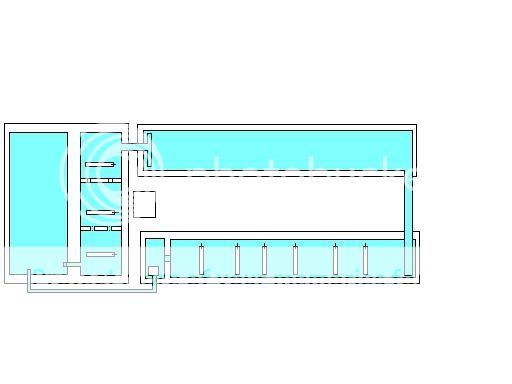
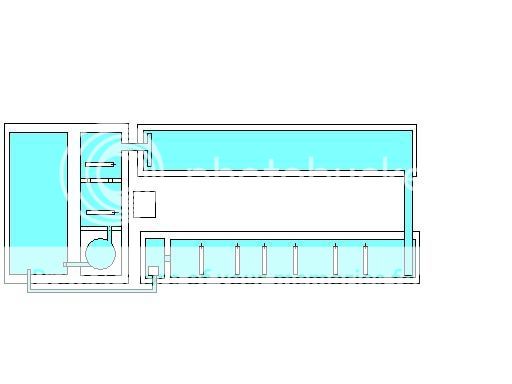
Fish tank with bottom feed overflow to a swirl filter then into the ABF(airlift bio filter or digester). The first DWC gb has no air stones as there should be enough o2 in the water. The second has added o2 but may not need it. Then the sump at the end pumps back to the FT. Main ft, swirl and filter made from concrete using a re-usable mould that you can sit over reo and mesh. DWC gb's with V'ed bottom so any fine solids can be easily removed.


Top
 Profile  
Reply with quote  
PostPosted: May 19th, '09, 08:25 
Xtreme Contributor
Xtreme Contributor

Joined: Jan 20th, '09, 07:11
Posts: 208
Gender: Male
Are you human?: YES
Location: Uriarra, Southern NSW, Australia
Dufflight, they are like those mc esher drawings where you can't tell where the levels start and stop :P so thanks for the explanation. Hadn't thought about V bottomed channels, but my reading of them is that the fines are taken care of by the bacteria living on the walls and floor of the channel and even some on the underside of the rafts. Am also hoping to avoid a swirl filter and use all the solids in the GB's. Worst case I can add one later if I push the fish side of things harder. But that is why this is only a trial system.

Sleepe, I suspect the logistics of getting the roots to water as seedlings may prove problematic and require some adjustable height device and associated complexity. Also the beauty of the rafts is that they are a) are light for easy handling, b) are supported by the water so don't have to be strong, and c) exclude light from the channels and so limit algae growth, d) relatively cheap and available, e) if the water height changes so raft rises and falls with it (granted solved by a constant height system), f) the raft water contact surface accommodates bacteria g) the rafts are relatively unaffected by water (no rust, rot etcetra). They damage fairly easily and they are not very UV stable (fixable by painting topside).

Thinking aloud, I suppose you could glue strips of raft to the underside at 2 foot intervals that would float the raft an inch above the water, but it would sink down as the plants grew heavier, hmmm....


Top
 Profile  
Reply with quote  
PostPosted: May 19th, '09, 08:44 
A posting God
A posting God
User avatar

Joined: Apr 3rd, '08, 01:57
Posts: 2256
Location: Australia Sydney
Gender: Male
Are you human?: yes
Location: Gods own country,Sydney South
heading down the commercial line of thinking changes many ideas normally accepted in a backyard situation.
For one , cascading beds on a sloped area makes good use of land , but a price is to be paid in additional pumping costs.
Aeration needs to be efficient / cost effective ..... Do you have any bore holes near ?? Do you have a bore hole drill?

Large cost reductions can be achieved with correct design , minimum pumping to height and efficient water oxygenising.
Also , I assume you have 3-phase power available ???


Top
 Profile  
Reply with quote  
PostPosted: May 19th, '09, 08:53 
Almost divorced
Almost divorced
User avatar

Joined: Dec 28th, '06, 15:25
Posts: 1326
Location: Canberra
Gender: Male
Are you human?: Vegetable
Location: Canberra
I say embrace technology and get familiar with a drawing program. :lol: The more time you spend drawing it up, the less time you'll spend having to re-landscape your farm.

Instead of having the DWC totally level, what happens if you put an ever so slight slope on it? Such that gravity gives you a bit of a kick for the water moving down to the sump (which is just a deeper area of the DWC?). Hrrm, scratch that, the water in-water out method would give you a good grip on how quickly it flows, where as the slope is unchangeable.

Ok here's another idea, how about reversing it completely? You have your DWC in big F off ponds at the top of a hill, then you have your "Fish tanks" which are just EDPM lined beds ever so slightly inclined so that it's basically a stream. The water overflows from the DWC into the "stream" which your fish live in. The stream flows down the hill, taking with it all the solids, and ends up in a sump, the sump pumps everything back up through some growbeds which empty into the DWC tanks... I suppose you would need to shade the "fish streams". With some tweaks it could be robust. Just an idea :cheers:


Top
 Profile  
Reply with quote  
PostPosted: May 19th, '09, 08:56 
A posting God
A posting God

Joined: Sep 15th, '07, 09:09
Posts: 3712
Location: WA
Gender: Male
As I said McFarm no experience with DWC. Its just that if you look at an NFT gutter the plants are suspended. It would just be a mathmatical calculation to determine the floatation to allow the plants to sit at a fixed height ie bottoms of the pots at water level. Attaching polystyrene ribs running lengthways should theoretically strengthen the beds in one direction. Movement of the water down the trough would provide a small movement of air from one end to the other yet humidity should remain high. As to the beds sinking this should be minimal if the ribs are wide enough.
This was just an idle thought :)


Top
 Profile  
Reply with quote  
PostPosted: May 19th, '09, 09:00 
Seriously, this cant be healthy.
User avatar

Joined: Dec 6th, '07, 01:13
Posts: 10709
Images: 0
Location: central FL
Gender: Female
Are you human?: YES at least mostly
Location: USA, Florida, Yalaha
I have done DWC where the "net pots" are in boards that rest on the lip of the tank and the level of the water is below the bottom of the "net pots" This takes care of the waterlogging issue but it does make getting seedlings started a bit trickier (this can also be an issue in NFT culture where there is only a thin film of water in the trough and the bottom of the net pot is suspended above the bottom of the trough. Some people deal with this by top watering till the seedlings get their roots down into the water. My solution was to equip my "net pots" or yogurt cups in my case with rayon string as wicks (good will mop head strings in my situation.) This has allowed me to start seeds directly in the cups right in the system and skip the whole part of transplanting the seedlings into the net pots and into the system. Check out the last several pages (I'm guessing here but it has probably been in place only a month or two) in my system thread for pictures of my wicks in the cups for my recent addition of the NFT tubes into my system design. Or my personal web pages has pictures of my old hydroponics stuff
http://www.hydroponics.tclynx.com/
and a little way past half way down the page is some pictures of my yogurt cups with wicks. With the wicks you can have the water an inch or so below the bottoms of the cups and the seeds can still get enough moisture to germinate and send their roots down the wicks and into the water leaving a nice air gap below the cups for good air exchange.
Main drawback I see here is that resting sheets of foam or whatever above the surface of the trough, there is more chance that a storm wind could take off with a board full of cups and seedlings. And if everything is heavy enough not to take off in a wind, it will be hard to move things along in a conveyor belt fashion. It think the surface tension of the way may help a great deal in keeping the rafts in the beds under normal windy conditions.

And to the standpipe note. I agree with OBO even if you are doing external loop siphons, it is still worth while to leave yourself access to the drain without having to dig media out of the bed. It is handy to be able to uncover the drain access to check the flood and drain operation on occasion and clear roots as needed. I'm becoming even more supportive of keeping everything easily accessible and easy to maintain as my system teaches me new things.


Top
 Profile  
Reply with quote  
PostPosted: May 19th, '09, 09:08 
Xtreme Contributor
Xtreme Contributor

Joined: Jan 20th, '09, 07:11
Posts: 208
Gender: Male
Are you human?: YES
Location: Uriarra, Southern NSW, Australia
Thanks all much food for thought, and will pay attention to servicability.

Chappo, unfortunately only single phase. However a mate is an energy efficiency consultant of the solar kind and he is all about saving power. He is coming over next week. Brother in law is a mechanical engineer (heating and aircond in commercial buildings) and commercial building energy rating assessor too. So I'll be using their nous to keep energy use to a minimum, the obvious being head heights and pumping requirements. The trial system will be to see what we can get away with in this area and the costs involved. Also money/cost is but one leg of the stool. If money were paramount I'd buy a turnkey package and it would be all about ROI.

No bore holes or drill, but 5 springs that have been turned into capped wells and piped to a central point which deliver 50l/min + continuous. Water from these is hard as nails but very clean.


Top
 Profile  
Reply with quote  
Display posts from previous:  Sort by  
Post new topic Reply to topic  [ 24 posts ]  Go to page 1, 2  Next

All times are UTC + 8 hours


You cannot post new topics in this forum
You cannot reply to topics in this forum
You cannot edit your posts in this forum
You cannot delete your posts in this forum
You cannot post attachments in this forum

Search for:
Jump to:  
cron

Powered by phpBB® Forum Software © phpBB Group
Portal by phpBB3 Portal © phpBB Türkiye
[ Time : 0.092s | 18 Queries | GZIP : Off ]