The Sunday times in Ireland just ran a two page spread about aquaponics Yesterday.
The text is a bit hard to read so I'll copy and paste it below. Seems that my brother, Nigel, might be one of the only people doing aquaponics in Ireland, so they contacted him and wrote up a nice article. They buggered a few bits up here and there, but not bad really. Just waiting for Nigel to start getting knocks on his front door now from people wanting to see his IBC set ups.
His systems have their fair share of problems over there, like 2 inches of ice in the fish tank during winter.. Makes if damn hard to feed the fish...
A biological science graduate is working on an experiment that may turn us into not only a nation of home food producers but also back-garden fishermen. Nigel Malcolm, an Australian who lives in Headfort, Co Galway, and is an environmental impact consultant, is carrying out the first back-garden aquaponics experiment in this country.
He has set up two tanks containing a mix of goldfish and perch. At timed intervals, a pump takes water from the fish tanks to a gravel tray mounted over each tank. Salads and herbs for Nigel’s table grow in the gravel, which provides a biological filter for the fish tanks.
The fish waste removed from the water provides super-nutrients for the plants, which grow faster in this rich medium than if planted in the ground.
Aquaponics, a new model for food production, may have not only the potential to turn tiny back gardens into rapid-growth food farms, but also to produce fresh organic fish for the table. Take it to a commercial scale and record amounts of fresh food might be produced in factory-type spaces in cities, without creating any pollution.
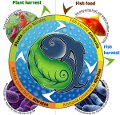
Aquaponics links two movements: aquaculture, which is fish farming, and hydroponics, the production of food plants without soil, usually by using nutrient-enriched water or gravel.
The method varies from project to project but the principle is the same. Fish farming produces huge amounts of concentrated waste which is an environmental hazard. Food plants thrive on fish-waste fertiliser, so aquaponics joins the two: the dirty water produced by the fish is filtered and eaten by the plants, in turn causing rapid growth and high food yields and returning clean water to the fish.
The result is an environmentally friendly self-sustaining model for food production that is as suited to back gardens as it is to city factory units.
Nigel, who works for Moore Archeological & Environmental Services, has seen home aquaponics in action thanks to his brother, Joel, who produces 60 fresh fish a year from his back garden in Perth, Australia, as well as fresh salad and vegetables. Joel operates the world’s largest aquaponics website —
http://www.backyardaquaponics.com — and produces a magazine on the subject.
Joel also puts his waste food into a wormery. This makes compost and worms, and the latter provide food for the plants and the fish to complete the nutrition circle. Yabbies (Australian crayfish) clean waste in the fish tanks and provide additional food.
Joel has been advising his brother. “I’ve been running those tanks for three years now,” says Nigel. “I’ve got goldfish and perch, which I got from the fisheries board, and I grow salads and herbs in the trays. The big surprise is the wild strawberries which we just dug up out of a lane and plonked in the trays.
“Like my brother, I use the same sort of hard clay balls that people use in the tops of plant containers. I have a pump set on a timer so that at intervals the waste water is pumped up and it floods the tray above. The clay balls get covered in bacteria as a result and the plants thrive on these. The action filters the water for the fish.
“The model has worked reasonably well and the set-up survived getting frozen in the winter. What it has proved, however, is that it’s too cold to do outdoors in Ireland. It gets so cold in winter that the fish become dormant and stop growing. The solution is to move the aquaponics system into a polytunnel or greenhouse to extend the growing season of both the plants and the fish.” And this is his next plan.
There is yet another benefit to the method: the ability to grow food while saving water. Joel’s backyard system, which can be seen on YouTube (“backyard aquaponics”) allows him to grow food despite hosepipe bans or water restrictions. This is likely to become an important consideration in Ireland, too, when the expected metered domestic water charges roll in next year.
Joel’s system uses only 10% of the water required for a normal garden because the water is recycled, whereas in an ordinary vegetable patch, it sinks into the ground or evaporates.
The potential, as he points out, could be huge. Already, large city-based initiatives in America and Asia are supplying fresh fish, salad and vegetables to commercial levels.
One of the greatest aquaponics success stories was set up in Milwaukee, which is bitterly cold in winter and often has snow from November to March. Growing Power, a community project, was founded by Will Allen, a former professional basketball player, in an abandoned factory complex.
Working with the University of Wisconsin, Allen has set up a multifaceted eco system that will next year produce a record 100,000 fresh tilapia for restaurants and shops, as well as tonnes of fresh salads.
The project, which combines composting and wormeries with aquaponics has already produced a million pounds of fresh food in a year from an indoor aquaponics facility.
To see the project, key in “Growing Fish in Greenhouses” and “Growing Power and Milwaukee” into YouTube.
In America, aquaponics systems farm tilapia, a fast-growing fish native to the Nile Delta. In China and Malaysia such facilities concentrate on carp or shrimp.
As far as the Irish project is concerned, Nigel says there’s no reason why a range of renewable features could not be introduced into the system. “You could insulate the polytunnel or greenhouse with light-admitting materials and you could introduce a heat bank by using concrete floors and beds to store the solar heat,” he says.
“Then you can use regular solar power from panels to contribute. Worms from a wormery could provide food for the fish to cut down on using expensive and environmentally costly foods. It’s definitely something we plan on looking into.”
Indeed, back-garden polytunnels and greenhouses may be the only way forward for aquaponics in Ireland because, according to a rather unenthusiastic BIM, the sea fisheries board, there are no large-scale commercial trials on the go. The main reason for this, says Damien Toner, a spokesman for BIM, is because most fish farmers are focused on producing fish only.
They are reluctant to entertain notions of plant-food production, even if filtration by plants means cutting out expensive mechanical systems and transforming the process from being environmentally offensive to environmentally friendly.
Also BIM insists that native fish are produced, which leaves us with perch (an underrated food fish) and trout as the only viable options for back-garden fish/food farming.
“We would certainly rule out the farming of non-indigenous fish species, at least not without looking into each case in some detail,” says Toner.
It would take some rather un-Irish creative business thinking and equally un-Irish enthusiasm from local authorities and Government regulators to get big-picture aquaponics off the ground here and get abandoned factories in Dublin, Cork or Galway City producing aisles of fast-growing tomatoes, carrots and salads for the city markets as well as healthy fish.
Red tape means the small picture is far more likely. But just imagine: you pop out from your kitchen to your polytunnel or greenhouse and net yourself a fat trout for the pan.
From the trays above you pick some dill to flavour him and dig up some spuds to make the chips, plucking a lemon off the tree on your way back. Fresh fish and chips from your own garden.
Here's a pic of one of Nigels IBC systems from a few years back..
 Backyard Aquaponics