⚠️ This forum has been restored as a read-only archive so the knowledge shared by the community over many years remains available. New registrations and posting are disabled.

All times are UTC + 8 hours


Post new topic Reply to topic  [ 18 posts ]  Go to page 1, 2  Next
Author Message
PostPosted: Jul 29th, '09, 13:35 
Newbie
Newbie

Joined: Jun 19th, '09, 03:32
Posts: 22
Gender: Male
Location: urban
I'm wondering about using the water from an existing duck pond as a fertilizer for some soil beds in a large community garden project. While this isn't straight aquaponics, a couple of the ideas are pretty close and I would greatly appreciate any thoughts/info about how to help it work on the bacteria end of things. Part of the challenge for my situation is I don't have access to electricity outside of a small solar panel.

So what I'm thinking of doing is using a bait tank pump, the kind on a fishing boat. Those are pretty good for pumping out solids, not getting clogged, it's 800 gph and enough power for what I need. It also runs on 12VDC, so if I get a car battery, use a small solar panel I have as a trickle charger then run the pump a few times/day for just a couple of 2 min bursts, the pump piece hopefully should work. (link: http://hopkins-carter.com/store/p515/800-GPH-Bait-Sentry-Livewell-Pumps---1700-011-030/product_info.html

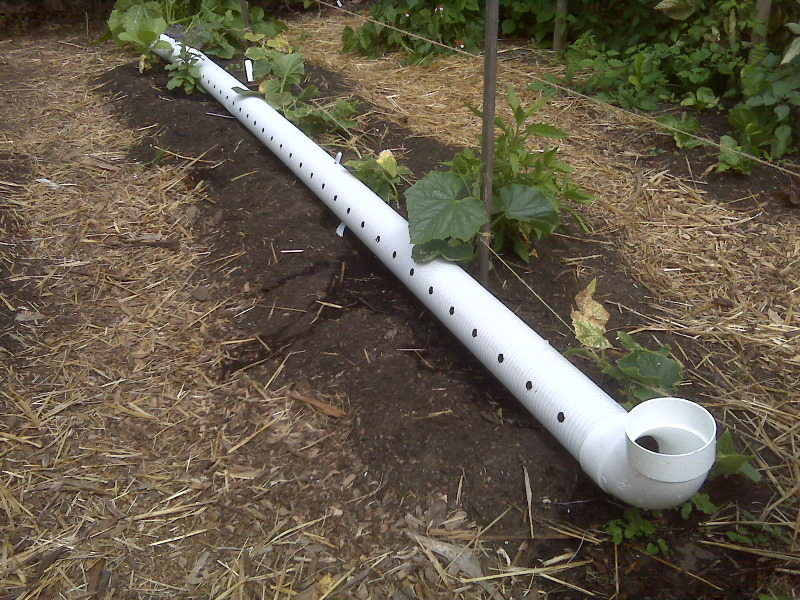
The best I've come up with for water distributing is using 4" pvc perforated drain pipe, in 10' lengths, since my beds are 30' long, 3 strung together. The rough volume is 3.14 x 1/6'^2 x 30' which gives a bit over 2.5cf which is just under 20 gallons. So I put a cap on the end of the 30' section of pipe, turn the pump on for a little over a minute (it's a 800 gph pump) and the 30' section fills up and then slowly drains out. I make sure to have the pipe laid out such that the drain holes are right at the bottom and that there's enough room for the water and some solids to drain out (maybe the pipe is elevated a tiny bit?) I'd have to operate the system manually, and for most of the beds, once things get growing, it'd be too hard to move a 30' section of pipe with the plants growing all over it, so I'd have to invest in a bunch of pipe. 10' sections go for about $7 out here, so that's not too bad, since they should last pretty much forever. Assume I can get the pipes roughly level or that I put plants that need more water towards the sloped end.

I could design a simple pvc connector on the 30' pipe sections in the beds that accepts a tube from the pond pump, I manually hook the tube up to a 30' pvc section, turn on the pump for a minute plus, disconnect the tube (connector is above the level of the pipe, so no backflow), move on to the next row. Fertilize 20 beds in less than an hour, move 400 gallons of water, refill the pond with clean water, do the same thing every other day.

So, a couple of questions. First, any thoughts on the pump/distribution system? Obvious problems, easy improvements?

Second, I'm still wondering, how "nutritious" would this duck water be for plants given whatever bacterial systems will be in place in the top few inches of soil in the soil beds? Would it be every bit as good as a fully functioning aquaponics system? Would the top inch or two of soil (assume good quality, airy soil with mulch/plants to block out light and it stays at least somewhat moist a few inches down) work just like whatever grow medium in an aquaponics system or not as good? Would the soil system take a few weeks to get going and then be great?

Thanks for any help or thoughts


Top
 Profile  
Reply with quote  
    Advertisement
 
PostPosted: Jul 29th, '09, 20:24 
A posting God
A posting God
User avatar

Joined: Sep 4th, '07, 04:16
Posts: 2475
Location: Texas
Gender: Male
Are you human?: YES
Location: Texas 75703
I would settle the water in one tank and overflow to a second tank with heavy aeration (water pump or large air pump) before sending the water to the dirt. This will break it down, clean it up, and prevent anaerobic slime from forming in and around the irrigation pipe; nasty stuff.


Top
 Profile  
Reply with quote  
PostPosted: Jul 30th, '09, 17:03 
Newbie
Newbie

Joined: Jun 19th, '09, 03:32
Posts: 22
Gender: Male
Location: urban
Trick is I want those solids out of the duck pond and into the beds where they'll end up as fertilizer. I think the anaerobic mostly comes from being in water, and given that I'll only water the beds every other day or every third day, I'm thinking the slime will dry out and turn into dry solids and I would think it would break down nicely, no?

So I went out and got a few pieces of pipe and set up a test run. I manually filled the pipe with a five gallon bucket and watched to see what would happen. The holes are about 1/2" diameter, so unless it's a major stick or feather or something, any solids I bucketed up went out. There are two rows of holes in the pipe I'm using (with holes spaced about every six inches), so I put one set straight down. Because of the uneveness of the dirt, some of the holes were up in the air and the water came out of those much faster. But overall, the pipe filled, the water distributed and the pipe was mostly clean after.

I think one thing that would help would be to lay the pipe on a path of straw or something like that. It would help to even out and slow down the water drainage, catch the solids to a degree and let them start drying out and breaking down with the straw. It might turn out to be easiest to use a pump that outputs to a garden hose and just fill the pipes manually, walking around. I could drain the pond down to about half every other day, getting most of the solids off the bottom (hopefully). I'm almost nervous my water will be too clean and I won't get enough nutrients, so maybe I'll have to get a few more ducks :-)


Top
 Profile  
Reply with quote  
PostPosted: Jul 30th, '09, 19:39 
Xtreme Contributor
Xtreme Contributor

Joined: Jun 26th, '09, 21:47
Posts: 116
Gender: Male
Location: Silay City, Philippines
Dan D Man is quite right. You need to first get the stuff into a settling or treatment pond to decompose the wastes. The solids should settle down at the bottom of the pond and you can let the liquid effluent flow to the plants. You can use probiotics to accelerate the decomposition to a great advantage. Fresh biowaste will only compete with the plants for nitrogen which the bacteria will consume in the process of decomposition. The settling or treatment pond can be periodically emptied of the decomposed solids which would be very good fertilizer for your plants. Just my thoughts.


Top
 Profile  
Reply with quote  
PostPosted: Jul 30th, '09, 20:24 
Xtreme Contributor
Xtreme Contributor

Joined: Feb 26th, '08, 21:26
Posts: 224
Location: N.W. Arizona
Gender: Male
Ricko
I was unable to keep a pump running to a biofilter on my duck pond. The prefilter would plug and pass solids into the pump in short order. I ended up harvesting all the ducks and after cleaning the pond going to fish. Even now the pump will plug up. But the concept of watering the garden with fertile water is sound. We realize consistanly better plant growth and veggie yield with fish water.
My advice is make sure your pump will run reliably before investing in pipe. Perhaps if you rig the pump off the bottom it will avoid my problem.


Top
 Profile  
Reply with quote  
PostPosted: Jul 30th, '09, 21:21 
Seriously, this cant be healthy.
User avatar

Joined: Dec 6th, '07, 01:13
Posts: 10709
Images: 0
Location: central FL
Gender: Female
Are you human?: YES at least mostly
Location: USA, Florida, Yalaha
Here is a little test you can do before investing too much in the idea. Take something like a net and try to scoop out solids from the duck pond and plop a wet blob of the solids down somewhere. Come back and see what you think of the plop of solids the next day. Did it dry out to a dusty thing or has it turned into a slick that won't let water through. Will your garden require constant poking with a stick under the "duckigation" pipes to allow the next run or irrigation water to soak in instead of running out over the top of the previous muck.

From a "gray water" type of stand point, perforated pipes generally don't work evenly for long since over time the solids do build up at the holes and certain parts along the pipes won't get evenly watered. You are probably better forming something like a mulch filled trench along the row and just discharge into the trench and skip the expense of the pipe all together.

Of course all of that is kinda skipping over the fact that duck poo should probably be composted before being used directly in a soil food garden. You might be better off with a settling tank (swirl filter) that you can remove the nasty solids from to go into a compost pile and then use some of the clear duck water for the garden.


Top
 Profile  
Reply with quote  
PostPosted: Jul 31st, '09, 13:59 
Newbie
Newbie

Joined: Jun 19th, '09, 03:32
Posts: 22
Gender: Male
Location: urban
I like the idea of taking some of the stuff off the bottom and seeing what it does when it dries out. My bet is at least half of it is mud. Ducks have this great habit of taking mouthfuls of mud from the side of the pond and swishing their mouth around in the water to see if they have any bugs. The mud comes out in the water and settles at the bottom, so I'm betting at least half or better of the stuff at the bottom will be dirt from the edges of the pond.

The rest should be poop, algea and other stuff, but is there any of that that is specially nasty? I'll see if I can get by the pond tomorrow to try out a shovel full or two and see how it looks over the weekend.

In terms of composting the solids first, that does make sense, but I'm looking for a low work strategy here. Granted I don't want to be lazy in a way that does harm to the garden or doesn't get the benefit that could come from other reasonable strategies, but I'm thinking if the holes are draining down into straw or some porous, spacious material (something organic with a lot of air gaps), I'm thinking the composting can just happen over time in the beds.

For the folks who suggested aeration, what does that help? I know almost nothing about what that actually does for water and what difference it would make, so if you could help me understand the benefits of aeration and the problems of not aerating, I'd appreciate it.

In terms of the mulch filled trench, that does make a lot of sense and that for sure is the lowest cost/easiest to do strategy. Only trick is it's a lot more work to go up and down each row watering each area and since this is pretty nasty water, I wouldn't want to get it on any of the plants where we're eating the leaves, either from direct spray or splash. So a system of trickle delivery seems like a benefit. If I do get to the point where I'm filtering out all the solids, I could just use soaker hose for the aqueous stuff, but so far, I'm not quite ready to give up trying to solve the solids distribution problem.

I'll see how the stuff dries out and I ordered a test pump (they said I can return it if it can't handle the solids) that I'll get next week early. So more updates forthcoming.

Thanks for all the info and good ideas


Top
 Profile  
Reply with quote  
PostPosted: Aug 1st, '09, 01:01 
Seriously, this cant be healthy.
User avatar

Joined: Dec 6th, '07, 01:13
Posts: 10709
Images: 0
Location: central FL
Gender: Female
Are you human?: YES at least mostly
Location: USA, Florida, Yalaha
I think the pipe with holes method will cause you more work than you know. If you can manage a small mulch filled trench, then the trick is to stick the end of the flexible pipe from the pump in under the mulch in one end of the trench. Flood the trench, shut off pump and move to next trench, repeat. This should put the solids down in the mulch and to an extent hopefully the poo and mulch will compost making more fertile ground where the trenches are. Hopefully the nutrient rich water will be available to the plants and the duck pond will be less smelly. You may find that the end you normally put the pipe in to flood the trenches tends to get more solids so you might move the point at which you place the pipe to share the solids a bit more evenly.

The hose out back to mulch pit seems to be the most trouble free method of dealing with "gray water". It is low tech and doesn't really have the problems with holes plugging up the way most drainage pipes do. It does take a bit of work periodically since the mulch pit/trench will slowly fill in with fine sediment and the break down of the mulch may cause the pit or trenches to need to be re-dug and fresh mulch applied. However in a garden, this is actually a bonus since the decomposed mulch and sediment tend to be really great humus for planting.

Now back to aeration. Aeration can help you avoid the nasty smelly conditions that happens when decomposition becomes anaerobic. The bacteria that like anaerobic conditions tend to cause a really nasty stink. The bacteria that tend to work in well aerated conditions tend not to cause a nasty smell.


Top
 Profile  
Reply with quote  
PostPosted: Aug 1st, '09, 02:02 
Newbie
Newbie

Joined: Jun 19th, '09, 03:32
Posts: 22
Gender: Male
Location: urban
Aaah, so aerating the water helps switch which bacteria are able to work on the decomposition process and turn the process from anaerobic to aerobic? That makes some sense. So is aerating more important for the water while it's in the pond to help with the processes there or as I distribute it to the soil beds? I would think as I distribute it, it's spreading out, not filling up any space, so it would be more of an aerobic process at that point. That's part of why I'm thinking about a material like 1/4" fir bark or pine bark fines or something like that to put under the pipe, to let the water spread out over a bunch of surface area, lots of oxygen and hopefully a high enough water to sludge ratio that the sludge doesn't take over. I'm wondering about filling the perf pipe with clean water once after filling it with duck water to help the solids get out and to help the solids spread out over the mulch. I'm thinking about ten minutes or so after the duck water drains?

Here's a rough picture of what I'm doing in one of the beds. I sure had overestimated how long the beds were, it was under 20', no where close to 30'. But this gives a bit of a sense:
Image

I'm heading out to Sonoma today to visit Hydrophilia and see what they're working on, but Saturday, I'll get to tinker around some and see how the sludge is doing,


Top
 Profile  
Reply with quote  
PostPosted: Aug 1st, '09, 06:36 
Xtreme Contributor
Xtreme Contributor

Joined: Aug 1st, '09, 04:04
Posts: 150
Gender: Male
Location: Ohio, USA
One word of advice about the solar/pump setup. I've been experimenting with solar/pump idea, so I thought I'd share.

First, it is not cheap! For instance, your typical dc pump (like the one you linked to) draws 4-5 Amps at 12 V (or, in other words, it is around a 60 W pump). So, you'll need at least 60 W (probably more like 100W), and then the pump may or may not run during the very middle of the day! (And solar panels are ~ $4/watt, so you're looking at around $250!)

I have two 15 W panels and since the pump I got (like the one you link to) doesn't work, I'm going to try the last one on this page:
http://www.cheappumps.com/products.php?al=solarpumps

Hope it works for you.
K


Top
 Profile  
Reply with quote  
PostPosted: Aug 2nd, '09, 06:10 
Almost divorced
Almost divorced
User avatar

Joined: Oct 17th, '07, 12:03
Posts: 1495
Location: Sonoma
Gender: Male
Are you human?: Y: I have affadavit
Location: Sonoma, California, USA
Hey, Rick!

Great having you come up to visit (and it gave me a chance to see my catfish. :lol: )

Sludge will often produce nice tough slime layers that are nearly impenetrable to water, but if you have plenty of worms in your soil and only add sludge once a day to once a week it may not get a chance to form. The only way to find out is to try...grab a couple 5-gallon buckets and some old clothes (or, even better, a sump pump) and have at it!

You will need a fast pump to water things evenly if all those holes in the pipe are unrestricted, probably several hundred gallons per hour. Actually, having the holes pointing down and partly blocked (sitting on mulch or soil) might be best, especially if you flush it occasionally as you mentioned.....but if the holes are up or down (with very long drain time), the pipes will fill with "sediment".

The duck-carried soil would definitely put a crimp in any flood/drain aquaponics as the growbeds would fill with soil fast. One would need either a settling tank or a way to prevent the ducks from carrying soil to the pond...


Top
 Profile  
Reply with quote  
PostPosted: Aug 2nd, '09, 15:01 
Newbie
Newbie

Joined: Jun 19th, '09, 03:32
Posts: 22
Gender: Male
Location: urban
My daughter is still in awe of the picture of you with a mask and snorkel in the fish tank. I haven't gotten to try the grafting yet, but I did practice a few cuts to see if I could open up the space to put the bud. So I'm still pretty impressed by the simplicity of your design, constant flow, timer built around water draining or filling from a container and toilet flapper valves that close to flood, and reopen when the fill container refills. Pretty elegant. Thanks a ton for letting me check it all out. I have a good friend here who I'm trying to sell on a trial installation of an ap project. He has solar panels at his place, so they produce an abundance of electricity and he has this nice, unused sunny spot, around 8' x 3' that would work nicely for a ~500 gallon tank covered with grow beds. He wants to come up next time (hint, hint :-) to get to see all your projects. I can bring worms next time, maybe on a Saturday so I don't mess up your work schedule? But thanks a ton for the first hand look and all the info.

In terms of my duck water into soil beds system, so far I'm pulling water from mid-height in the pond, so I haven't dealt with the solids that seriously yet. I ordered a Wayne pump that uses some tricky system to suck the water that allows for 1/2" pieces to get sucked up without clogging, so we'll see how that goes. It can output to a garden hose, so I'll try using that to fill the pipe, run it manually for a while. So far I've just been using five gallon buckets, dumping it in as fast as I can. I picked up the pipe today and put a layer of composted horse manure under it, lots of straw bits, enough structure left to keep good air space but enough density to slow down the water flow. I've got the holes pointed straight down, one of the main things I want to avoid is getting nasty duck water on the veggies themselves.

I finally have my solar panel/small pond pump set up reasonably stably so it's a 90 gph trickle from the duck pond into a bathtub with a foot or so of lava rock. I kept thinking I couldn't start growing anything because I didn't have a full system, I was thinking plant requirements were the same as the fish requirements. Once I got that through my head for the duck water into the soil beds, I realized I could put plants in my bathtub as well. A couple of tomatoes, a pepper, some basil and two squashes, but all of them were started in a green house with soil. We'll see how well they do in the transfer, especially the squashes, they don't like to have their roots touched. I'm messing around with some foil covered cardboard around the solar panel to boost the wattage. Just that simple piece jumped the wattage close to 10%, we'll see if I can make a parabolic cardboard frame, cover it with foil and see what I get.
Attachment:
tub pic.jpg
tub pic.jpg [ 62.79 KiB | Viewed 5104 times ]

Anyhow, thanks for the visit, the ideas and in all my messing with the solar panel, I forgot to get a shovelfull of sludge from the bottom of the duck pond and let it dry out. So I'll go by tomorrow and set it out in a place to dry out and see what we get. If it's mostly dirt and nothing too slimy, I'm hoping it'll do fine on the composted horse manure, we'll see how it goes.


Top
 Profile  
Reply with quote  
PostPosted: Aug 2nd, '09, 22:50 
Almost divorced
Almost divorced
User avatar

Joined: Oct 17th, '07, 12:03
Posts: 1495
Location: Sonoma
Gender: Male
Are you human?: Y: I have affadavit
Location: Sonoma, California, USA
Rickoxo wrote:
My daughter is still in awe of the picture of you with a mask and snorkel in the fish tank.
Tell her to bring a mask and snorkel herself! No need to net the fish...just going into the cave and visiting is a lot of fun.

Rickoxo wrote:
I have a good friend here who I'm trying to sell on a trial installation of an ap project. He has solar panels at his place, so they produce an abundance of electricity and he has this nice, unused sunny spot, around 8' x 3' that would work nicely for a ~500 gallon tank covered with grow beds. He wants to come up next time (hint, hint :-) to get to see all your projects. I can bring worms next time, maybe on a Saturday so I don't mess up your work schedule?

The more the merrier! Next weekend is open, but after that I'll be back east.

Rickoxo wrote:
In terms of my duck water into soil beds system, so far I'm pulling water from mid-height in the pond, so I haven't dealt with the solids that seriously yet. I ordered a Wayne pump that uses some tricky system to suck the water that allows for 1/2" pieces to get sucked up without clogging, so we'll see how that goes.

Some of those things are real beasts and do a fine job of taking raw sewage from a house below sewer level and sending it up to the sewer. Of course, that waste stream doesn't (well, shouldn't) contain feathers, but that pump should probably work well.

Rickoxo wrote:
I finally have my solar panel/small pond pump set up reasonably stably so it's a 90 gph trickle from the duck pond into a bathtub with a foot or so of lava rock.<>A couple of tomatoes, a pepper, some basil and two squashes<>. We'll see how well they do in the transfer, especially the squashes, they don't like to have their roots touched.

Are you trickling water through or doing flood/drain? Things will do better long term with the latter, but the former is easier to set up and will do for a test. Even squash transplant fine with flood/drain (especially in this crazy cool weather), but with trickle you walk a fine line between drowning and dry...or maybe there is enough dissolved O2 that the plants will be fine with a trickle whenever there is sun and nothing when there is none. It has possibilities....

Rickoxo wrote:
I'm messing around with some foil covered cardboard around the solar panel to boost the wattage. Just that simple piece jumped the wattage close to 10%, we'll see if I can make a parabolic cardboard frame, cover it with foil and see what I get.

I'm not sure of the temperature that will damage a panel, but you might check. It is the limiting factor on concentrating PV. Also, remember that the cell with the least sunlight is another limiting factor: if you have one cell with 1X solar and all the rest with 10X the output will be the low voltage of the hot cells and the low amperage of the 1X cell....


Top
 Profile  
Reply with quote  
PostPosted: Aug 9th, '09, 14:24 
Newbie
Newbie

Joined: Jun 19th, '09, 03:32
Posts: 22
Gender: Male
Location: urban
I was hoping this weekend could work but my buddy got sick, so maybe we'll try to catch you after you get back from back east.

So the word on the sludge from the bottom is that it all turned into bits and dust after it dried out. Ducks do the trick with a mouthful of mud in the water, but they also are a pain with their food. They like to eat it wet, so they often go get a bite of food, come over to the water, fill their mouth with water (spilling half the food) then eat what's left. So a bunch of the sludge in the bottom was water logged feed. Only trick I've seen so far is to keep food far away from water, so they eat seperate from drinking--I had forgotten to tell the folks at the pond who were doing the feeding. But the sludge dried out fine, looked like crumbly dirt, so it should be fine if I can get it out to the garden.

I hooked up the pump, hooked up a 3/4" garden hose to the outlet and watered the garden for a bit to try it out. Man the water smells (no where near enough water changes) and I don't want to get it on any part of a plant we'd like to eat. That's part of why I was messing with the tube delivery system, it makes sure the water just gets out to the dirt and not on the plants and so far has been working great for distribution. It seems to come out reasonably even and no significant sludge build up.

The solar panel booster is pretty small and not doing much in terms of heat, but if I were to build a bigger one, I might want to check the surface temp and make sure it's not getting too hot. I'm not sure about the part about the cell with the least light, maybe this is a newer panel with a different design? I can cover half of it, and all that happens is the pump height goes down, it doesn't shut off completely. So it seems to be able to get different levels of intensity over different portions of the panel and add it all up somehow I guess. Or was I misunderstanding what you were asking about?

The site with the duck pond is ripe for an ap system, I just can't quite figure out how with a limited budget, significant possibility of any serious pv equipment getting stolen and no access to electrical to pull it off. A dc pump, a set of car batteries storing electricity for the non-sunlight times and a small tank running at limited stocking, maybe I could get enough water movement to keep something like that working, but I think I'm going to switch gears and put in a system at my house first, get it up and going and make sure I get the details worked out. Once that is going well, I've got a couple of friend interested if it really does turn out to be as simple and stable as I'm saying it can be. Before I get going on the building, I'll start a new thread with my design ideas, let folks throw out comments and feedback, fine tune what I can before hand and then see how it goes.

Thanks again for all your help


Top
 Profile  
Reply with quote  
PostPosted: Aug 10th, '09, 14:18 
Almost divorced
Almost divorced
User avatar

Joined: Oct 17th, '07, 12:03
Posts: 1495
Location: Sonoma
Gender: Male
Are you human?: Y: I have affadavit
Location: Sonoma, California, USA
Rickoxo wrote:
I was hoping this weekend could work but my buddy got sick, so maybe we'll try to catch you after you get back from back east.

Just as well: I ripped heck out of the AP jungle today (had to prune away masses of tomato plant to get to the ripe ones, then ate them as dinner, hand-to-mouth. Different trellising next year!) and planted a lot of new stuff to be ready on our return. I'll keep in touch.

Rickoxo wrote:
The solar panel booster is pretty small and not doing much in terms of heat, but if I were to build a bigger one, I might want to check the surface temp and make sure it's not getting too hot. I'm not sure about the part about the cell with the least light, maybe this is a newer panel with a different design? I can cover half of it, and all that happens is the pump height goes down, it doesn't shut off completely. So it seems to be able to get different levels of intensity over different portions of the panel and add it all up somehow I guess. Or was I misunderstanding what you were asking about?

I was talking about solar panels in general. The post applies to systems where there are a number of separate panels or cells in series. Not applicable to yours. Mea culpa. Also yours looks like an amorphous (rather than crystalline) silicon panel and those are far less susceptible to heat.

Rickoxo wrote:
The site with the duck pond is ripe for an ap system, I just can't quite figure out how with a limited budget, significant possibility of any serious pv equipment getting stolen and no access to electrical to pull it off.

Too bad the duck pond is not higher up. If you set it on a stand it could solve most of your problems:
1) no soil as ducks will not bother bringing it up the steps or ramp.
2) no need for a pump as gravity would power a SLO setup: just run irrigation water in to the pond and let the runoff water the garden.
3) no stink as the water will be changed often
Of course, this assumes you have an irrigation source.

The only problem remaining (one many of us face) is how to distribute water to different beds at different times. Perhaps switch it once a day to another bed by hand...

Rickoxo wrote:
Thanks again for all your help

You are welcome to it.


Top
 Profile  
Reply with quote  
Display posts from previous:  Sort by  
Post new topic Reply to topic  [ 18 posts ]  Go to page 1, 2  Next

All times are UTC + 8 hours


You cannot post new topics in this forum
You cannot reply to topics in this forum
You cannot edit your posts in this forum
You cannot delete your posts in this forum
You cannot post attachments in this forum

Search for:
Jump to:  

Powered by phpBB® Forum Software © phpBB Group
Portal by phpBB3 Portal © phpBB Türkiye
[ Time : 0.137s | 17 Queries | GZIP : Off ]